Why am I painting flowers?
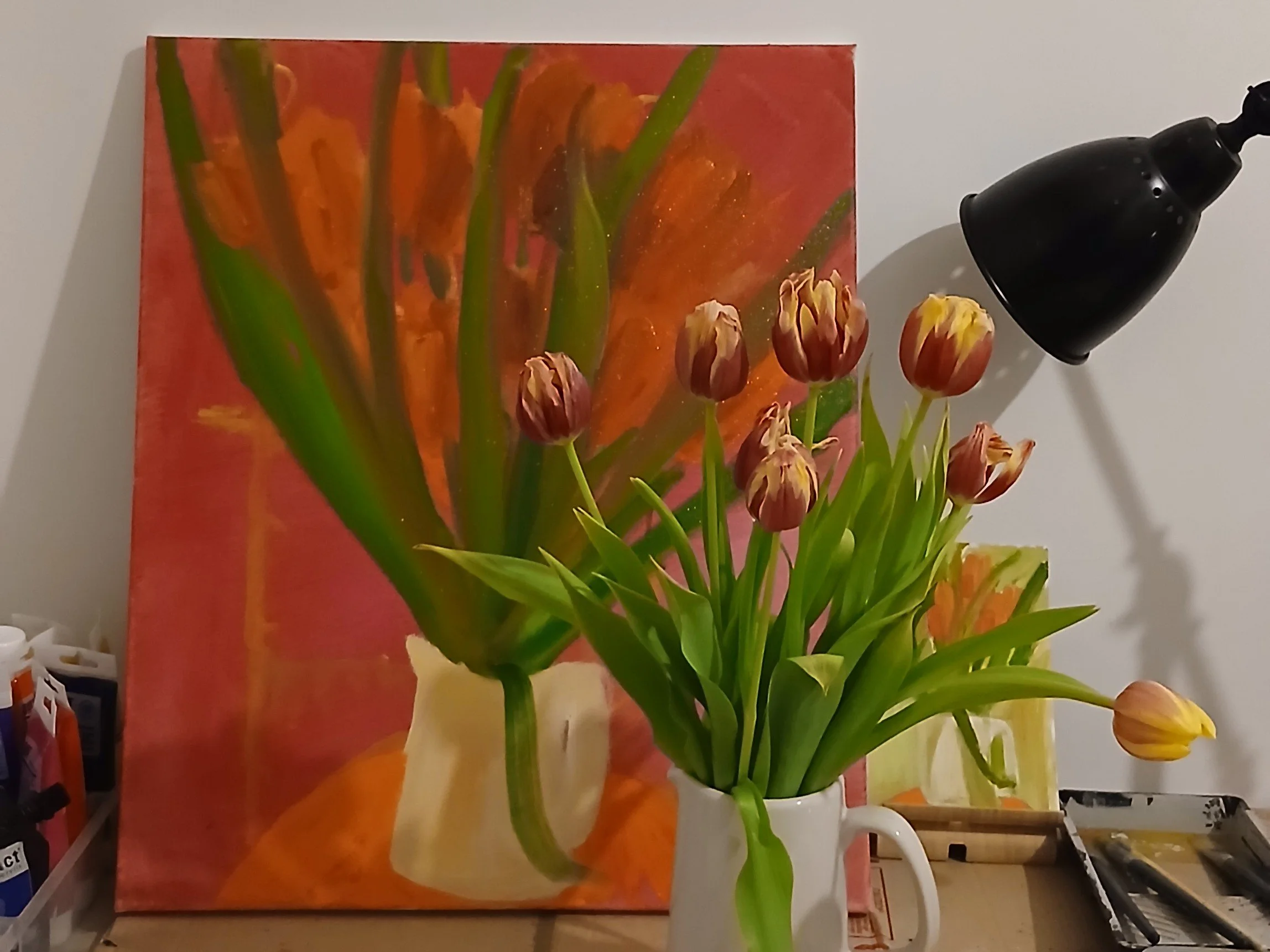
Tegfan Studio. Painting tulips at night. Jan 28th 2026
Dear friends,
Painting can be a wonderful distraction from the horrors of the world. But it can also become a purposeful, deliberate act to highlight injustice, inequality, abuse, trauma and the horrors of war. Think of Picasso’s ‘Guernica’ or Paula Rego’s "Abortion Series" (1998–1999) - a powerful collection of paintings, created in protest after a 1998 referendum failed to legalize abortion in Portugal. Her work is credited with the shift in public opinion which led to the legalization of abortion in Portugal in 2007. Painting has survived conceptual claptrap. There are more painters today than ever before. I went to art college, when painting was loudly and obnoxiously declared dead. But here we still are. Painting our stories, painting our lives. Some painters, have become famous and well known - thank god - we have our own Welsh born artist, Shani Rhys James who paints large scale self portraits that depict confrontationally unsettling, domestic scenes. She says “The female becomes part of the decoration; unable to be on the world stage she turns inward and obsesses about her interior space.” I recognise that statement profoundly, as a stay at home single mum in the 1980s and 1990s, feeling invisible yet branded a burden to society in all the National Papers - whilst I struggled to make ends meet and keep my baby warm in Thatcher’s Britain, and STILL trying to make art in the sexist patriachal society that ruled the misogynistic working class housing estates of South Wales.
The American artist Cindy Sherman and English artist Sarah Lucas, well known artists of my generation, are still making bold confrontational and shocking statements about the female body, form and function and the relatively young and wonderful Jenny Saville, with her gigantic glorious paintings of female flesh that thrust the uncomfortable question of what defines feminine nakedness in the face of the viewer. I’ve always admired the scale and sheer lusciousness of her style of painting. Here are three notably successful artists that refused to stay silent about inequality and injustice for women. There are many more - I’m not writing an essay here - I’m trying to get my head around why I’m painting flowers in a time of madness and cruelty and global wars where children suffer unimaginable agonies.
So why am I making paintings of flowers?
It’s certainly new to me. Flowers carry many complex associations with femininity - some obvious, some more subtle and have been used widely as a subject of feminine expression by other artists - the most obvious being Georgia O’Keefe. I’m exploring cut flowers, domestic flowers that are grown indoors - houseplants, potted flowers on a windowsill - to work out the more complex, somewhat disturbing domestic, familial relationships, often unseen and unspoken. I could just paint the human figure to portray this subject as I did in the 1990s, like Rego - but that feels too personal, too close to the bone - too distracting also. I needed to remove the faces and figures from the narrative and flowers presented themselves as the perfect poetic metaphor. Their appearance on the canvas is not as confronting as Saville’s imposing female figures. We have become used to a vase of flowers in a still life painting - a subject for enhancing a domestic interior space - a small player in the wider narrative of the painting. And neither is a painting of flowers, at first glance, as disturbing as Rego’s Abortion series - so how do I make the viewer look twice at these flower paintings?
The titles of my paintings have become an integral part of the work. I thought I could get away with numbering the paintings, but no, the viewer can not read my mind. They need the whole story. The titles hint at the deeper narrative of the painting - they politely hold the viewer’s hand through the series of works, which I’ve named “A Family of Fowers”. This series of work is holding my interest for far longer than I had imagined. I do not know why I have never before, fully understood how powerful and important the title of my own paintings would be. I have always been an autobiographical painter of sorts - unconcerned with how my paintings were viewed by others. Painting was my therapy, my work, my expression of completeness. It was too deeply personal for public display. And I suffered in my career as an artist because I refused to share my most successful and meaningful work in exhibitions. I think that had a lot to do with not understanding how to express or describe the work correctly. I wrote a lot of poetry at one time in my life and still ocassionally write short stories. And so, creating titles for my paintings, like titles of a poem or short story, make more sense to me now. A painting can be like a poem too. It can tell a whole story if you let it. That is what has reinspired my painting again.
In my sixtieth year - after what has become a lifetime of finding expression and identity through making art, I am late in coming to realise that painting must be shared for it’s influence to be ignited in the world - for it to serve as a force for good - or at the very least as a tiny spark that illuminates what it is to be human in this beautiful, miserable world. So this website and this journal page, with my thoughts and realisations about my practice is fast becoming an integral part of the whole. Forgive my slowness with photographing the work. It takes some time to set up a space for photography and daylight bulbs, reflector umbrellas are on order - Winter light is not ideal for getting the best images of a painting. - And anyway - nothing beats seeing a painting in real life - that’s another reason why exhibitions are so important for artists. Photographs are a poor imitation for the real thing.
Thank you for your support as always!
Joanne x
